PROJECT UPDATE: Density, and why planets are the wrong size
Mass and radius were independent numbers in Planetar, so the picture on screen could contradict the physics behind it. Tying them together with density, and rebuilding the presets around real mass ratios.
- Personal projects
- Work in progress
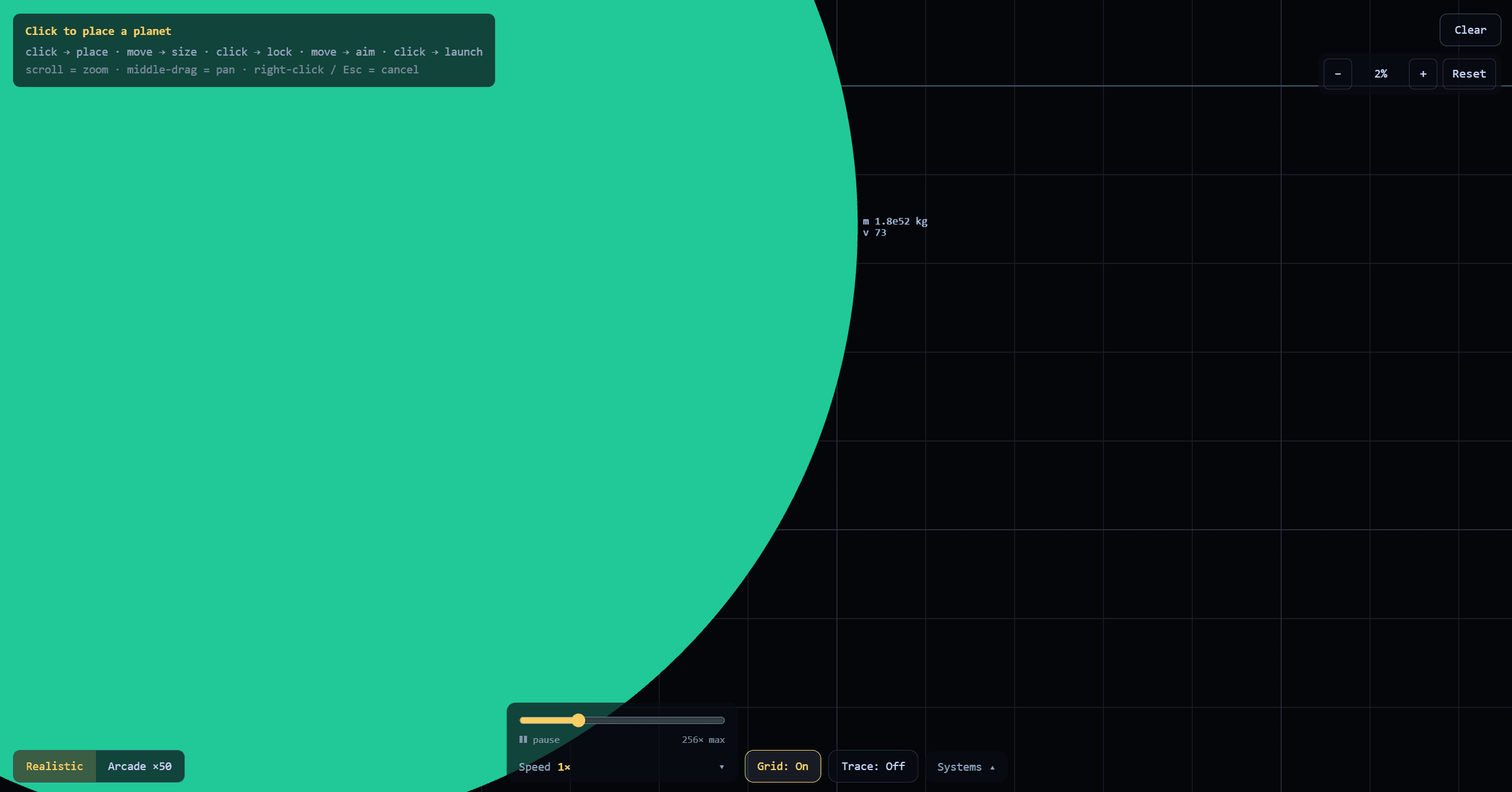
Until this point a body in Planetar had a mass and a radius, and they had nothing to do with each other. You could build a pea-sized object with the mass of a star, or a gas giant that weighed nothing. The simulation ran perfectly well — the integrator only ever reads mass — but the picture lied, because the thing you see on screen is the radius and the thing doing the physics is the mass.
That is a bad property for a tool meant to build intuition. This was the work of tying the two together, and then rebuilding the presets so their numbers mean something.
Density is the missing third term
Mass and radius are not independent quantities. Density is what relates them, and once it is in the model the editor stops needing you to keep two numbers plausible by hand:
ρ = m / V
For a sphere:
V = (4/3)πr³

m = ρ · (4/3)πr³
Which rearranges to the form the editor actually uses — pick a mass and a material, get a radius:
r = (3m / 4πρ)^(1/3)
The cube root is the whole reason planets do not look the way people expect. Radius scales as the
cube root of mass at fixed density, so a body a thousand times heavier is only ten times wider.
Jupiter is around 318 Earth masses and about 11 Earth radii — which is exactly 318^(1/3) ~ 6.8
adjusted for the fact that it is much less dense. That relationship is impossible to hold in your
head and trivial to hold in a formula, which is a good argument for putting it in the tool.
The part I have not got right yet
Real density is not a constant per body, and this is where the model is still honestly wrong.
A rocky planet is roughly 5.5 g/cm³ and a gas giant is roughly 1.3 — but a gas giant is not uniformly 1.3 anywhere. It is a compressible envelope over a dense core, and its average density falls as it gets larger while its central density climbs. Past a certain mass, adding more material barely changes the radius at all: Jupiter and a body several times its mass are nearly the same size, because gravity compresses the interior as fast as you add to it.
Doing that properly means integrating hydrostatic equilibrium against an equation of state:
dP/dr = −G · m(r) · ρ(r) / r²
dm/dr = 4πr² ρ(r)
which is a genuinely different project from a gravity sandbox. What is in there now is a per-body density with sensible per-class defaults — rocky, icy, gaseous, stellar — which gets the ordering and the rough proportions right and does not pretend to be more than that. The commit message for this one says "still need to figure out how to do the densities right", and that is accurate.
Rebuilding the presets around real ratios
With density in place, the predefined systems could stop being aesthetic arrangements and start being scaled ones. What matters is not absolute values — the engine runs in its own units — but that the ratios between bodies hold.
The one that reframes everything is the mass ratio to the central star. In the real solar system, every planet combined is about 0.13% of the Sun's mass. Which is why the two-body approximation works so well, and why a system of planets that all noticeably perturb each other is a system with implausible masses in it.
Distances have the same problem in the other direction, and it is the reason every diagram of the solar system you have ever seen is a lie: the orbits are so much larger than the bodies that an honest rendering is a blank page with a few invisible dots. Presets here compress distance and keep mass ratios, which is the trade that keeps them watchable while keeping the physics recognisable.
Orbital velocities come out of the masses rather than being tuned by hand:
v = sqrt(GM / r)                 circular
v = sqrt(GM (2/r − 1/a))         vis-viva, for elliptical starts
Getting these from M rather than by eye is what makes a preset stable on load. Before this, a
system that looked settled would slowly unwind, because the starting velocities were approximately
right rather than derived.
There is a satisfying check that falls out for free. Kepler's third law says the square of the period goes as the cube of the semi-major axis:
T² = 4π²a³ / GM
Nothing in the engine implements that — it only ever sums forces. So when a preset's outer bodies come back around at the intervals Kepler predicts, that is the integrator agreeing with a law it was never told about. Which is the most reassuring thing a simulation can do.
The source is on GitHub(opens in a new tab), and it is running at ivan-chaos.github.io/planetar-fe(opens in a new tab).