PROJECT UPDATE: Nineteen thousand pairs a frame
An all-pairs gravity summation is quadratic by construction, and the speed controls had made that impossible to ignore. Halving the constant, removing a square root, and knowing where the real ceiling is.
- Personal projects
- Work in progress
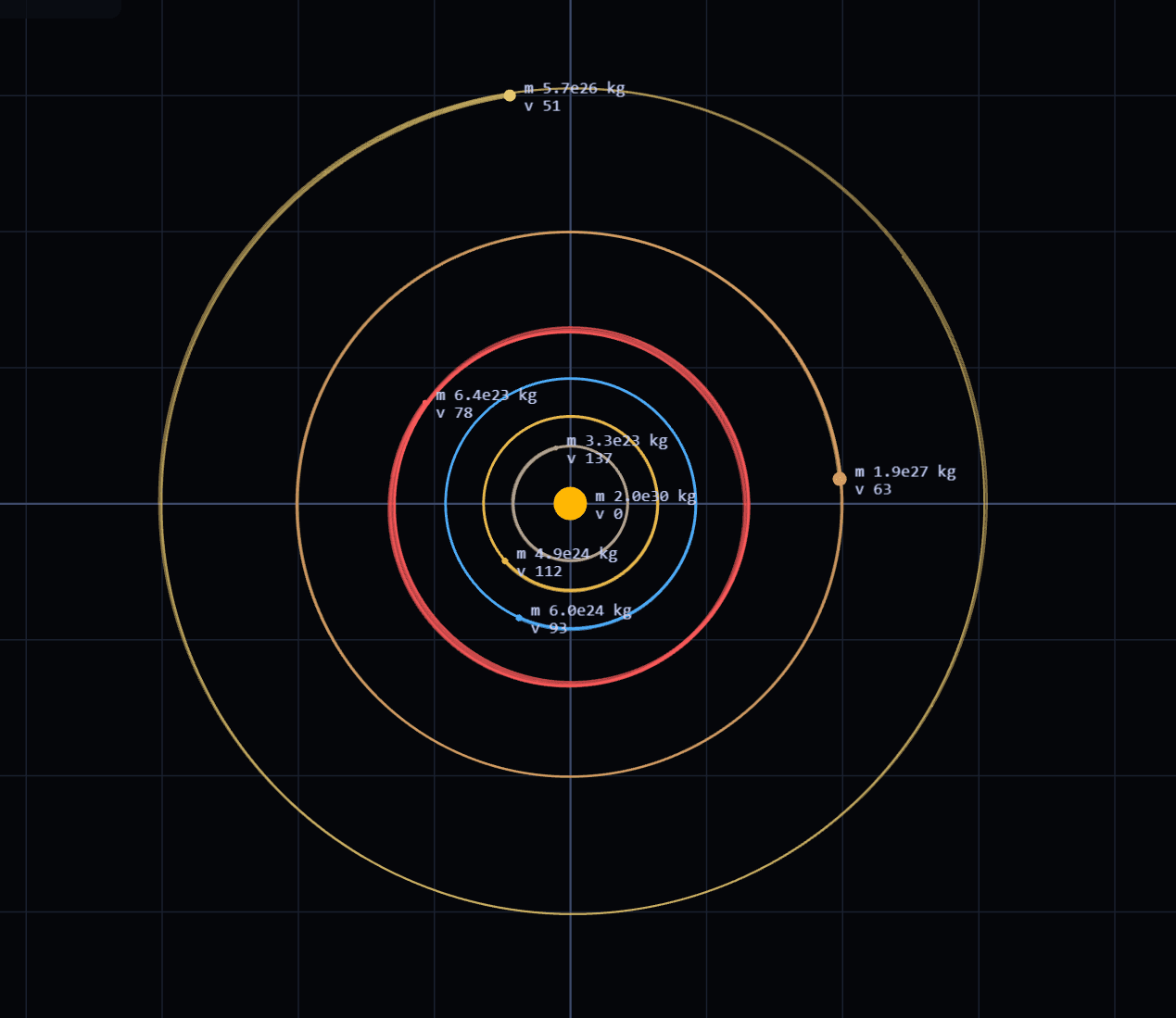
The speed controls from a few days earlier had made the performance problem impossible to ignore. Running at ten times speed means ten integration steps per frame, and each step is the full all-pairs force summation. A system that was comfortable at one times speed was dropping frames at ten, and the presets I had just added were the largest systems yet built.
The shape of the cost
Nothing here is a mystery. The force summation is O(n²) by construction — every body pulls on every other — and the number of distinct pairs is:
pairs = n(n-1)/2
Which is the whole problem in one line, because it is quadratic in a place where the input grows:
   n = 10    ->       45 pairs
   n = 50    ->    1,225 pairs
   n = 100   ->    4,950 pairs
   n = 200   ->   19,900 pairs
Multiply by the steps-per-frame multiplier and a 60fps budget of 16.7ms, and 200 bodies at ten times speed is 199,000 force evaluations per frame. The arithmetic per pair is trivial. Doing it two hundred thousand times, sixty times a second, is not.
Pairs, not ordered pairs
The first and largest win costs nothing and changes no results. Newton's third law says the force
body j exerts on body i is exactly the force i exerts on j, reversed:
F(i,j) = −F(j,i)
The naive loop computes both. Iterating j > i and applying the result to both bodies computes each
pair once:
for i in 0..n:
  for j in i+1..n:
    f = force(i, j)
    acc[i] += f / m[i]
    acc[j] -= f / m[j]
Half the work, identical output. It is still O(n²) — the constant is halved, not the growth — but halving a constant on the hottest loop in the program is worth having before anything cleverer.
The square root you do not need
The other free win is in the distance. Written directly, the acceleration term wants |r|³, and
|r| is a square root — one of the more expensive operations available, sitting in the innermost
loop.
But |r|³ can be written entirely in terms of the squared distance, which is just a dot product:
d² = r_x² + r_y² + ε²
|r|³ = (d²)^(3/2) = d² · sqrt(d²)
One square root instead of the three you get from computing |r| and cubing it, and the softening
term folds into d² for free rather than being applied afterwards.
Beyond the constant factor
Halving a quadratic is still quadratic, and the honest answer to O(n²) is to stop computing every pair. The standard approach is Barnes–Hut: subdivide space into a quadtree, and when a distant cluster of bodies is far enough away, treat it as a single body at its centre of mass instead of summing its members individually.
"Far enough away" is one ratio — the width of the cell s against the distance to it d, compared
against a tolerance θ:
s / d < θ -> treat the whole cell as one body
which takes the cost from O(n²) to O(n log n). With θ = 0 it degenerates back to exact all-pairs;
around θ ~ 0.5 the error is small and the saving is large.
It is worth knowing where the ceiling is even when you have not built up to it. The cheap wins above bought back the frame budget at the system sizes that actually exist in the app, and a quadtree is overhead that only starts paying at sizes those presets do not reach yet. The point at which that stops being true is a measurement, not a guess — which is why the profile above is the part of this work worth keeping.
The other half: drawing
Some of the same day went into the traces — the paths bodies leave behind them. They had been drawn at a fixed width, which is wrong in a view you can zoom: a line that reads well at one scale becomes a smear at another, and dozens of overlapping smears make a busy system unreadable.
Dividing the stroke width by the camera scale keeps the trace a constant width on screen rather than in world space:
w_screen = w_world / k
There is a cheaper win hiding in the trace buffer too. A trace is a ring of past positions, and there is no reason to store every frame's — sampling every few steps and capping the buffer length holds both the memory and the per-frame draw call count flat, however long you leave the simulation running.
The general lesson is the dull one, and it held here: the expensive part was not where it felt like
it was. It was in the loop that runs n² times per step, and the fixes that mattered were the ones
that removed work rather than the ones that did the same work faster.