PROJECT UPDATE: Writing a gravity engine from scratch
Starting Planetar, and why a general physics library was the wrong tool for it. Newton's law, the singularity you have to soften, and the two-line change that stops orbits spiralling apart.
- Personal projects
- Work in progress
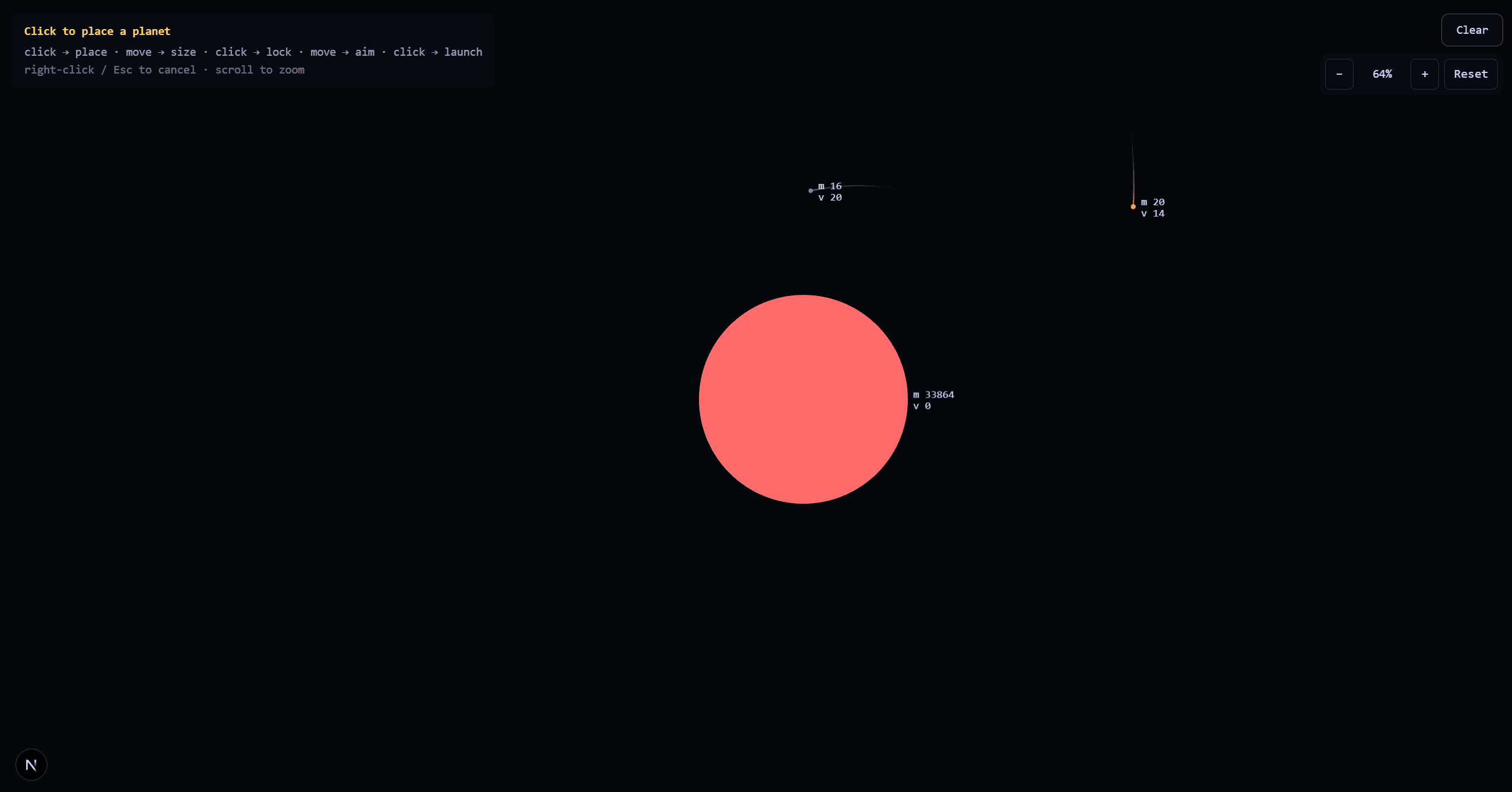
Two commits on the same afternoon: a bare Next.js scaffold, and then the thing I actually wanted to write. Between them is the only interesting part of starting a project — the moment you stop arranging the tooling and find out whether the idea works at all.
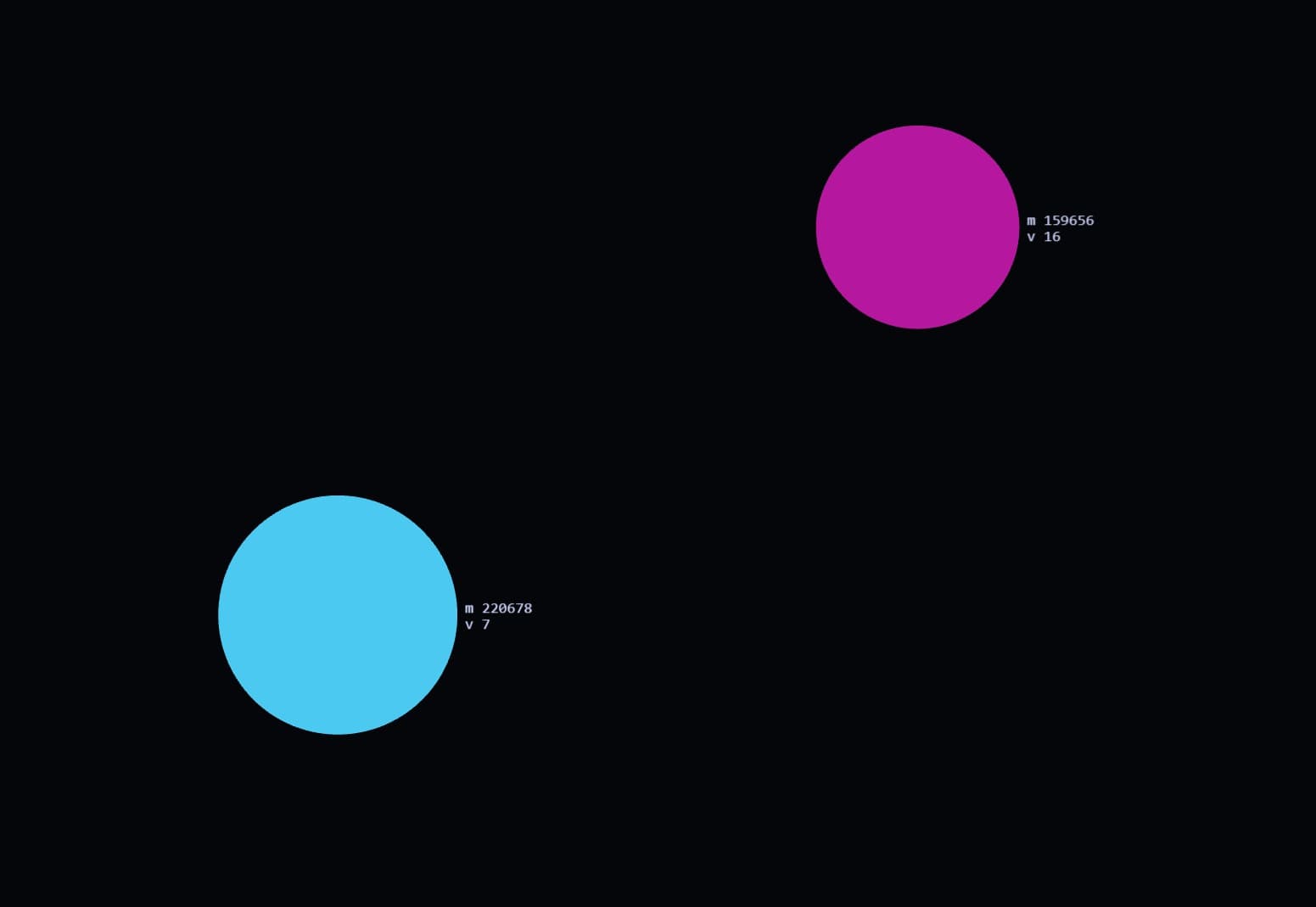
The idea: a browser sandbox where you place bodies, give them mass and a shove, and watch what the gravity between them does. Not a visualiser playing back a precomputed path. An actual integrator, running every frame, where nothing is scripted and a system either holds together or it does not.
Why write the engine
The obvious move is to reach for a physics library. I did not, and the reason is narrow enough to state plainly: general 2D physics engines are built for contact — rigid bodies, collisions, constraints, friction. Almost all of their machinery is solving problems this simulation does not have, and none of it is solving the one it does, which is a long-range force acting between every pair of bodies at once.
Gravity is the opposite shape of problem. Nothing touches. Everything pulls on everything, forever, at any distance. That is a handful of lines of arithmetic and one hard decision about how to step it forward in time — and once you have written those lines, a library is a dependency that mostly gets in the way.
So packages/engine is its own package, with no rendering in it and no knowledge that a canvas
exists. It takes a system, advances it by a timestep, and hands back the new state.
The arithmetic
Newton's law of universal gravitation, which is where every gravity simulation starts:
F = G · m1 · m2 / r²
A scalar force is not directly useful, though — I need a vector to add to a velocity. Writing it as
the force on body 1 from body 2, with r the vector between their positions:
r     = p2 − p1
r_hat = r / |r|

F12   = G · (m1 · m2 / |r|²) · r_hat
Then dividing through by m1 to get acceleration, and folding the normalisation into the
denominator — which is why the cube shows up, and why the code looks slightly wrong the first time
you read it:
a1 = G · m2 · r / |r|³
With more than two bodies it is a plain superposition: every body's acceleration is the sum of the pulls from all the others.
a[i] = G · Σ  m[j] (p[j] − p[i]) / |p[j] − p[i]|³
         j!=i
That summation is the whole engine. It is also the reason performance became its own problem later —
it is O(n²), and the pair count grows as n(n−1)/2, so a system of 200 bodies is doing about 20,000
force evaluations every single frame.
The singularity you have to handle
|r|³ in a denominator has an obvious failure mode: as two bodies approach each other, the
acceleration goes to infinity. In a continuous universe they would swing past on a hyperbola. In a
discrete one they teleport, because the timestep let them get far closer than a real trajectory ever
would, and then the next frame flings one of them off the screen at an implausible speed.
The standard fix is a softening length — a small constant that quietly puts a floor under the distance:
a[i] = G · Σ  m[j] (p[j] − p[i]) / (|p[j] − p[i]|² + ε²)^(3/2)
         j!=i
At normal separations ε² is negligible and the result is unchanged. At very close range it caps
the force instead of letting it run away. It is not physically truthful, and it is the difference
between a simulation you can leave running and one that detonates.
Stepping it forward
Having an acceleration is only half of it. The other half is turning it into motion, and the naive choice is worse than it looks.
Explicit Euler — read the acceleration, move the velocity, then move the position with the old velocity — is the version everybody writes first:
p[n+1] = p[n] + v[n] Δt
v[n+1] = v[n] + a[n] Δt
It does not conserve energy. A circular orbit under explicit Euler spirals outward, steadily, forever — not because of a bug but because of the method. Swapping two lines so the position update uses the new velocity gives semi-implicit Euler, which is symplectic and keeps orbits closed:
v[n+1] = v[n] + a[n] Δt
p[n+1] = p[n] + v[n+1] Δt
Same cost, dramatically better behaviour. It is the cheapest correctness win in the whole project.
What a first prototype is for
It looked terrible. There was one speed, no zoom, no way to pan, and placing a body meant editing a literal in the source. None of that mattered, because the question a prototype exists to answer is narrower: does a system of bodies given plausible initial conditions settle into orbits that stay closed for minutes at a time, or does it fall apart?
It stayed closed. Everything after this is interface, correctness at the edges, and making it fast enough to be worth watching.
The source is on GitHub(opens in a new tab).