PROJECT UPDATE: A system is just its initial conditions
Saving and loading planetary systems, which turns out to be a very short file — plus the predefined systems that came almost free once import existed.
- Personal projects
- Work in progress
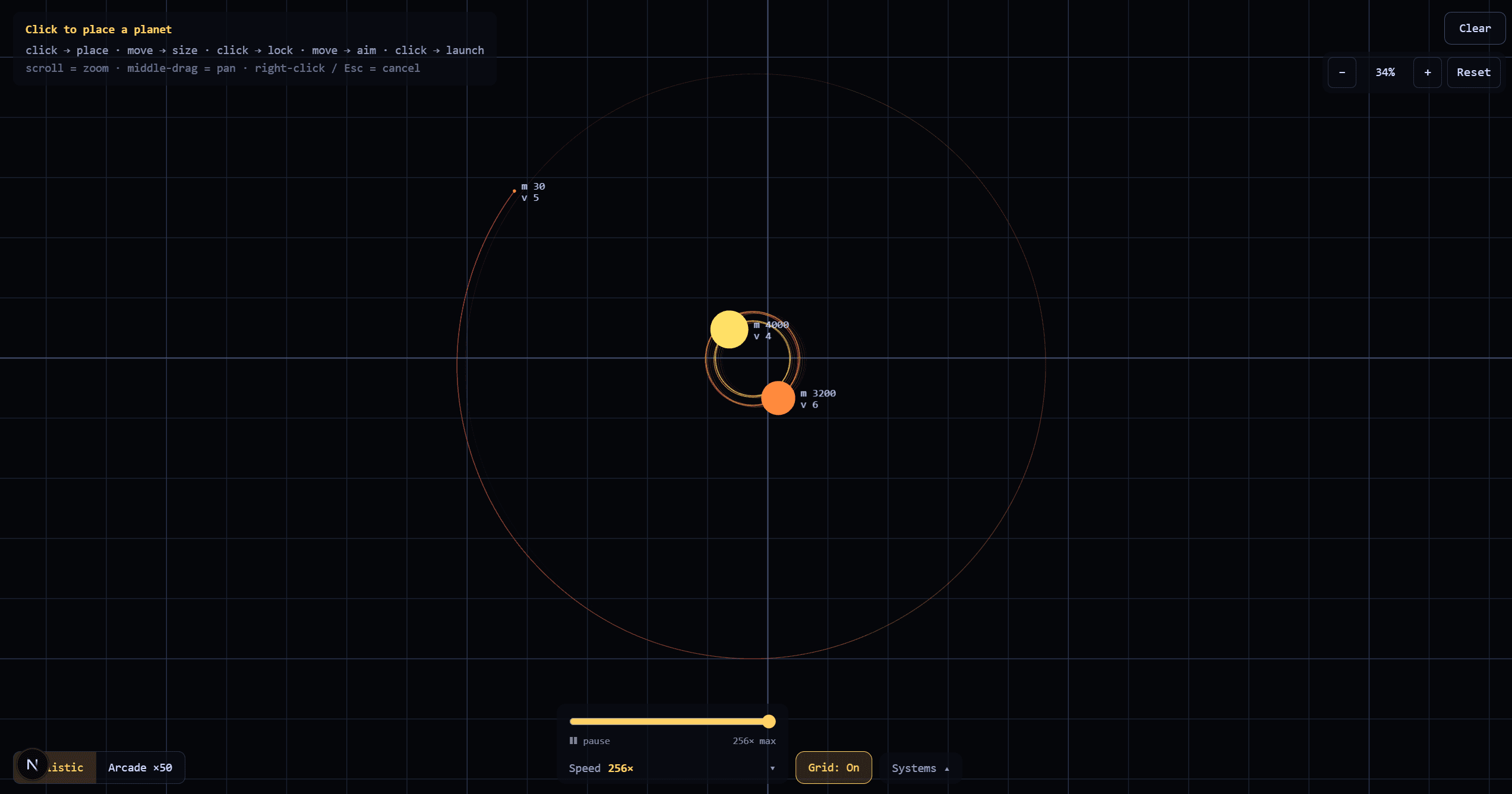
Every good configuration in the simulator was, until this point, unrepeatable. You would nudge bodies around until something interesting settled into place, watch it for a while, and then lose it — to a refresh, to a stray click, to changing one mass to see what happened.
That is a bad property for a sandbox. If you cannot save a state you cannot compare two of them, and comparing two of them is most of what the thing is for.
A system is just its initial conditions
The useful realisation is that there is almost nothing to save. A gravitational system is entirely determined by the state of its bodies at one instant — position, velocity, mass — plus the constants the engine runs under. Everything after that instant is derived. The traces, the orbits, the near misses: none of it is state, all of it is consequence.
So the export is a flat list:
System
  +-- meta      name, a note, the schema version
  +-- constants G, ε (softening), Δt
  +-- bodies[]  { id, mass, radius, position {x,y}, velocity {x,y}, colour }
Small enough to read, small enough to hand-edit, and small enough to paste into a message. That last one matters more than it sounds — a system you can send to someone is a system you can ask a question about.
Versioning it from the start
The schema version field went in before there was any second version to distinguish, which felt
like ceremony at the time. It is not. The alternative is discovering, three format changes later,
that you have files in four shapes and no way to tell them apart except by guessing at which keys are
present. One integer now is much cheaper than a heuristic later.
Units, and the part that bites
The awkward question an export forces you to answer is what the numbers mean.
Real values are unusable directly. Earth's mass is 5.97 x 10^24 kg; the gravitational constant is
6.674 x 10^-11. Multiply those in float64 across a few hundred pairs per frame and you are burning
precision on exponent bookkeeping for no benefit — the simulation does not care about kilograms, only
about ratios.
So the engine runs in its own units, and G absorbs the scaling. Picking a mass unit M, a length
unit L and a time unit T, the simulation constant is:
G_sim = G_real · (M · T²) / L³
Which means G is not a constant of nature in the file — it is part of the file's units, and it has
to travel with the bodies. An export that saved masses and positions but not G would be a system
that replays differently depending on what the app happened to be set to when you opened it.
Predefined systems
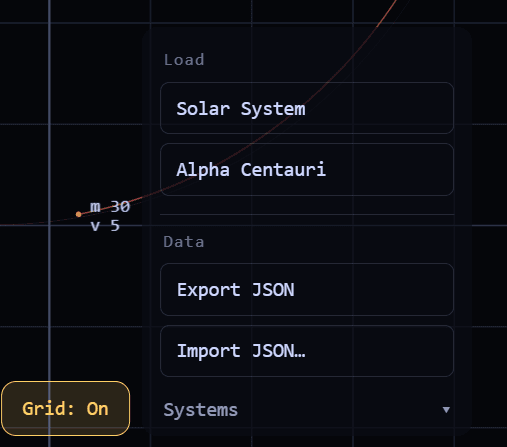
Once import existed, presets were nearly free — a preset is an import that ships with the app. What they cost is choosing them, which turned out to be the real work.
A preset has one job: to show something the simulation does that you would not have found by placing bodies at random. Two bodies falling together shows almost nothing. What earns a slot is a configuration with behaviour in it:
-
A binary pair, to show that two bodies orbit a shared barycentre rather than one orbiting the other. The barycentre is worth writing down because it is the thing people misremember:
R = (m1p1 + m2p2) / (m1 + m2) -
A star with several planets, which is the case people expect, and the one that makes the speed controls worth having.
-
A three-body configuration, because chaos is the honest headline result of this whole exercise: two systems started a pixel apart diverge completely, and there is no closed-form solution to appeal to.
Circular starting velocities come from setting gravitational and centripetal acceleration equal:
GM/r² = v²/r -> v = sqrt(GM / r)
Perpendicular to the radius, and the system holds. A few percent off and you get an ellipse instead — which is often the more interesting preset.
What it changed
Import and export sound like plumbing, and mostly they are. But they turned the simulator from something you play with into something you can take notes in: save a state, change one mass, load the original back, and see the difference. That is the difference between a toy and an instrument.